Meiji prints
The Meiji period in Japan denotes the 45-year reign of the Meiji Emperor running from 23 October 1868 to 30 July 1912. For Japan this was a period of major upheaval. With his naval fleet admiral Perry from the United States had just forced the Japanese people to open up to the outside world. This event resulted in the introduction of Western inventions like photography and bookprint presses in Japan, threatening to put many experienced woodblock print carvers and printers out of business. As a result of all the isolated centuries spent in passing down the crafts of woodblock carving and printing from one generation to the next in a master-pupil relationship, carvers and printers still in business at that time of Japanese history seem to have been at the very top of their craftman abilities.
The prints produced in the Meiji era that I was able to obtain are displayed on this page. Please click on any of these images to find out more about their size, publication date, provenance, enlargements, and the English translation of the Japanese texts on each print.
Some of these prints are special in the sense that they were not published separately but as free additions to magazines and novels. These prints called kuchi-e (literally meaning: mouth-pictures) typically have two clearly visible vertical folding lines. Along these lines, kuchi-e prints were folded in order to fit them into the magazines and books - smaller in size than the prints themselves - to which they were added as freebees. This is how a kuchi-e print - in this case ‘The scent of chrysanthemums’ by Kajita Hanko, see below - looks when folded:
-Folded-new.jpg)
A fascinating account of the historical context and technical aspects of the making of these kuchi-e prints can be seen in this YouTube video of David Bull.
Another special type of Japanese woodblock prints from the Meiji era are those that were published in the form of illustrated orihon or folding albums. Prints in illustrated orihon would first be published separately until the time when a designated number of prints for a certain series had been produced. Once the designated number of prints for a certain series was ready, the publisher would bundle and sell them all together in a folding album. These folding albums usually contain an extra title print showing both the series title as well as a list of the names of the individual prints. Famous examples are the 100 Aspects of the Moon folding album containing 100 tate-e (i.e., vertical or portrait prints) designed by Yoshitoshi and the Shin Bijin (True Beauties) folding album containing 36 tate-e prints designed by Chikanobu.
A number of orihon published in the Meiji period by publisher Akiyama Buemon (firm name Kokkeidō) and publisher Matsuki Heikichi (firm name Daikokuya) were based on sets of twelve ōban-sized yoko-e (i.e., horizontal or landscape prints), each print usually dedicated to one month of the year and always containing the series title in a cartouche located in the right margin of the print. By necessity these yoko-e had to be folded in order to accomodate them into the illustrated orihon book format in which they were issued. These yoko-e are therefore characterized by one clearly visible vertical fold right down the middle of the print.
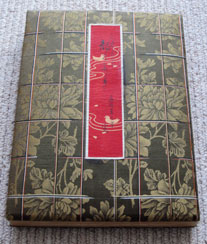
This is how one of these horizontal print orihon or folding albums - the Mitsui Gonomi folding album with prints designed by Mizuno Toshikata - looks when closed and seen from the front (left), and when opened to one of its pages (right):
 |
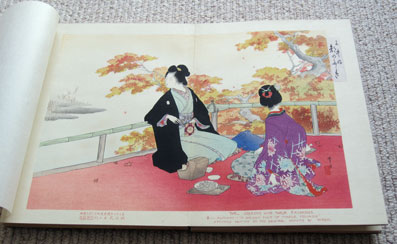 |
| Front cover of the Mitsui Gonomi folding album of Mizuno Toshikata | Opened Mitsui Gonomi folding album displaying one of its prints |
As unfortunately often happens with Japanese illustrated books (irrespective of the era in which they were published), dealers and owners tend to take these albums apart and then sell the prints separately in order to increase profits. However, for prints extracted by dealers and owners from orihon or folding albums in the Meiji era the vertical fold (and sometimes also the glue residues found on both the left and right border of the verso of these prints where the prints were glued together) still identifies them as having originally been part of an album.
Considering all this, it is interesting to note that horizontal prints issued in these folding albums lacking a central vertical fold (i.e, published separately) are therefore generally older (and therefore potentially more valuable) than those including a central vertical fold (i.e, published later as part of an orihon album).
So far I have been able to obtain yoko-e from the following twelve thusly illustrated orihon or folding albums all issued in the Meiji era, either by publisher Akiyama Buemon or by publisher Matsuki Heikichi:
- Arai Kanpō’s Shōnen Rekishi album published ca. 1900-1910s by Akiyama Buemon (3 prints)
- Bihō’s complete Azuma Sugata album published ca. 1910 by Akiyama Buemon
- Ikeda Shōen’s complete Yaekasumi album published in 1906 by Akiyama Buemon
- Ikeda Terukata’s complete Edo no Nishiki album published in 1903 by Akiyama Buemon
- Ikeda Terukata’s complete Senshu no Hana album published in 1897 by Akiyama Buemon
- Mizuno Hidekata’s complete Katei no Hana album published in 1907 by Akiyama Buemon
- Mizuno Toshikata’s complete Imayō Bijin album published in 1898 by Akiyama Buemon
- Mizuno Toshikata’s complete Mitsui Gonomi Miyako no Nishiki album published ca. 1905-1906 by Akiyama Buemon
- Yamamoto Shōun’s complete Shiki no Nagame album published in 1906 by Matsuki Heikichi
- Yamamoto Shōun’s first Kodomo Asobi album published in 1906 by Matsuki Heikichi (1 print)
- Yamamoto Shōun’s third Kodomo Asobi album published in 1907 by Matsuki Heikichi (4 prints)
- Yōshū Chikanobu’s Azuma Fūzoku album published in 1901 by Matsuki Heikichi (8 prints and its title page/table of contents)
Some of these prints are older, not having a vertical fold, while others - clearly containing a vertical fold - were published later as part of an orihon or folding album.
To my knowledge, only one other such yoko-e illustrated orihon or folding album was published in the Meiji era. This is Yamamoto Shōun’s second Kodomo Asobi album published by Matsuki Heikichi in 1906.
About the Japanese writing in these Meiji folding albums
In contrast to modern Japanese, originally hiragana - one of the two phonetic writing systems of Japan - had several forms for a single sound. These variant forms of hiragana are called hentaigana. As an example, consider the Japanese characters in the title of the album designed by Yamamoto Shoūn published by Matsuki Heikichi in 1906. The Japanese title of this album is 四季能な可免, which is pronounced as Shiki no Nagame, and translates into Scenes of the four seasons (see below for the complete contents of this album).
The meanings of the characters 能, 可, and 免 in this title are ‘ability’, ‘allowed’, and ‘excuse’, respectively. In the Meiji title 四季能な可免, however, the meanings of these three characters are completely ignored and they are only used for their sounds. These sounds are ‘no’, ‘ga’, and ‘me’, corresponding to the hiragana の, が, and め, respectively. In modern Japanese, hentaigana are hardly ever used anymore. Nowadays, this album title would therefore typically be written as 四季のながめ (Shiki no Nagame).
For more information on hentaigana, please refer to this Wikipedia page.
-thumbnail.jpg) Yōshū Chikanobu (1838-1912) - Beauty no. 35 in the Shin Bijin (True Beauties) series |
-thumbnail.jpg) Yōshū Chikanobu (1838-1912) - Beauty no. 24 in the Shin Bijin (True Beauties) series |
-thumbnail.jpg) Yōshū Chikanobu (1838-1912) - Beauty no. 18 in the Shin Bijin (True Beauties) series |
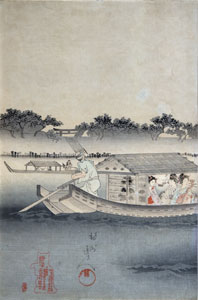 Yōshū Chikanobu (1838-1912) - Monday - Autumn moon over the Sumida river (left) |
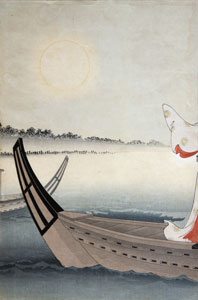 Yōshū Chikanobu (1838-1912) - Monday - Autumn moon over the Sumida river (middle) |
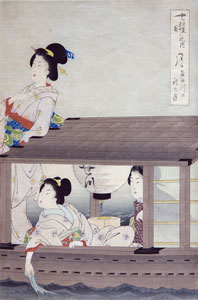 Yōshū Chikanobu (1838-1912) - Monday - Autumn moon over the Sumida river (right) |
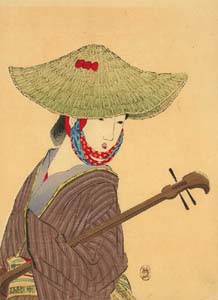 Takeuchi Keishū (1861-1943) - New Year’s street musician |
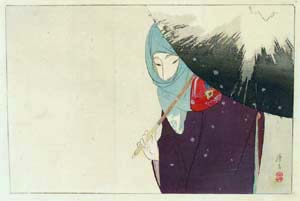 Tomioka Eisen (1864-1905) - Woman with umbrella |
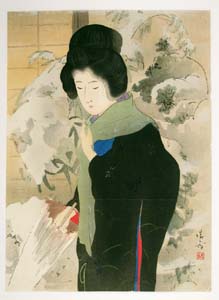 Kaburaki Kiyokata (1878-1972) - Light snow |
-thumbnail.jpg) Kajita Hanko (1870-1917) - The scent of chrysanthemums |
||
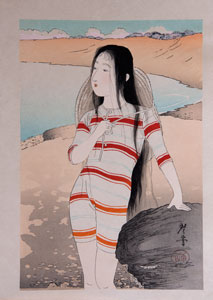 Terasaki Kōgyō (1866-1919) - Sea-bathing beauty |
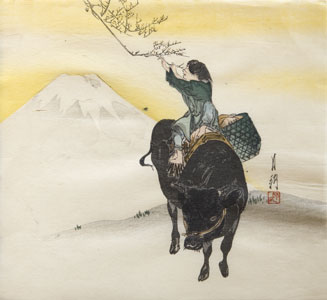 Ogata Gekkō (1859-1920) - Boy on an ox picking blossoms |
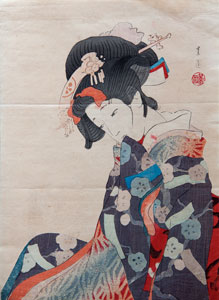 Ikeda Shōen (1886-1917) - The end of spring |
-thumbnail.jpg) Kobayashi Kiyochika (1847-1915) - Rain at Shin Ōhashi bridge, Tokyo |
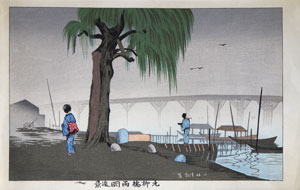 Kobayashi Kiyochika (1847-1915) - Distant view of Ryōgoku at Moto Yanagi bridge |
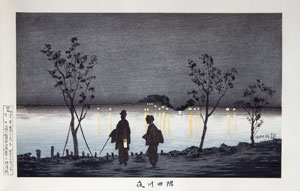 Kobayashi Kiyochika (1847-1915) - Sumida river at night |
Left-thumbnail.jpg) Kobayashi Kiyochika (1847-1915) - February: A snowy twilight at Matsuchiyama hill (left) |
Middle-thumbnail.jpg) Kobayashi Kiyochika (1847-1915) - February: A snowy twilight at Matsuchiyama hill (middle) |
Right-thumbnail.jpg) Kobayashi Kiyochika (1847-1915) - February: A snowy twilight at Matsuchiyama hill (right) |
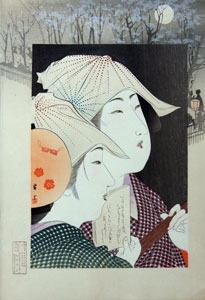 Yamamoto Shōun (1870-1965) - Ima Sugata: Misuji |
||
-thumbnail.jpg) Takejirō Hasegawa (1853-1938) - Sword & Blossom Poems: First album |
-thumbnail.jpg) Takejirō Hasegawa (1853-1938) - Sword & Blossom Poems: Second album |
-thumbnail.jpg) Takejirō Hasegawa (1853-1938) - Sword & Blossom Poems: Third album |
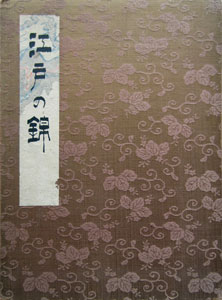 Ikeda Terukata (1883-1921) - Edo no Nishiki: Front cover |
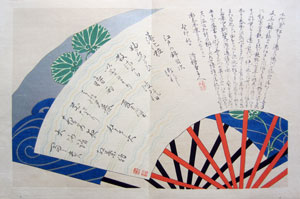 Ikeda Terukata (1883-1921) - Edo no Nishiki: Title page/Introduction/Table of contents |
 Ikeda Terukata (1883-1921) - Edo no Nishiki: Front cover Kees Berbee collection |
-thumbnail.jpg) Ikeda Terukata (1883-1921) - Edo no Nishiki: Light make-up |
-thumbnail.jpg) Ikeda Terukata (1883-1921) - Edo no Nishiki: Tediousness |
-thumbnail.jpg) Ikeda Terukata (1883-1921) - Edo no Nishiki: Flirting beauty on a mission |
-thumbnail.jpg) Ikeda Terukata (1883-1921) - Edo no Nishiki:Falling cherry blossoms |
-thumbnail.jpg) Ikeda Terukata (1883-1921) - Edo no Nishiki: Spring day |
-thumbnail.jpg) Ikeda Terukata (1883-1921) - Edo no Nishiki: Fine weather at the beach |
-thumbnail.jpg) Ikeda Terukata (1883-1921) - Edo no Nishiki: Seasonal rain |
-new-thumbnail.jpg) Ikeda Terukata (1883-1921) - Edo no Nishiki: Summer festival |
-thumbnail.jpg) Ikeda Terukata (1883-1921) - Edo no Nishiki: Twilight on a bridge |
-thumbnail.jpg) Ikeda Terukata (1883-1921) - Edo no Nishiki: Flower letter |
-thumbnail.jpg) Ikeda Terukata (1883-1921) - Edo no Nishiki: A lantern |
-thumbnail.jpg) Ikeda Terukata (1883-1921) - Edo no Nishiki: Autumn evening |
-thumbnail.jpg) Ikeda Terukata (1883-1921) - Edo no Nishiki: Big shore |
-thumbnail.jpg) Ikeda Terukata (1883-1921) - Edo no Nishiki: Autumn-leaf viewing |
-thumbnail.jpg) Ikeda Terukata (1883-1921) - Edo no Nishiki: Snow storm |
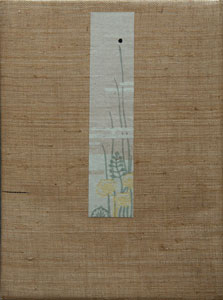 Ikeda Terukata (1883-1921) - Senshu no Hana: Front cover |
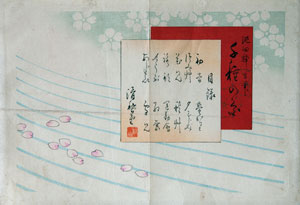 Ikeda Terukata (1883-1921) - Senshu no Hana: Title page/Table of contents |
|
-thumbnail.jpg) Ikeda Terukata (1883-1921) - Senshu no Hana: The beginning of the year |
-thumbnail.jpg) Ikeda Terukata (1883-1921) - Senshu no Hana: Picking herbs and wildflowers |
-thumbnail.jpg) Ikeda Terukata (1883-1921) - Senshu no Hana: Cherry blossom vieewing |
-thumbnail.jpg) Ikeda Terukata (1883-1921) - Senshu no Hana: Composing a poem |
-thumbnail.jpg) Ikeda Terukata (1883-1921) - Senshu no Hana: Irises |
-thumbnail.jpg) Ikeda Terukata (1883-1921) - Senshu no Hana: Hydrangea |
-thumbnail.jpg) Ikeda Terukata (1883-1921) - Senshu no Hana: Hunting fireflies |
-thumbnail.jpg) Ikeda Terukata (1883-1921) - Senshu no Hana: Enjoying the evening cool |
-thumbnail.jpg) Ikeda Terukata (1883-1921) - Senshu no Hana: Autumn grass |
-thumbnail.jpg) Ikeda Terukata (1883-1921) - Senshu no Hana: Sports day |
-thumbnail.jpg) Ikeda Terukata (1883-1921) - Senshu no Hana: Autumn leaves |
-thumbnail.jpg) Ikeda Terukata (1883-1921) - Senshu no Hana: Snow viewing |
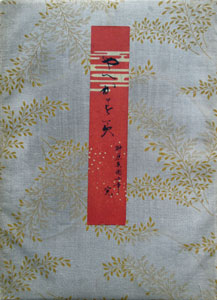 Ikeda Shoen (1886-1917) - Yaekasumi: Front cover |
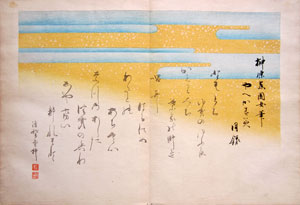 Ikeda Shoen (1886-1917) - Yaekasumi: Title page/Table of contents |
 Ikeda Shoen (1886-1917) - Yaekasumi: Front cover Kees Berbee collection |
-thumbnail.jpg) Ikeda Shoen (1886-1917) - Yaekasumi: A quiet talk over the brazier |
-thumbnail.jpg) Ikeda Shoen (1886-1917) - Yaekasumi: A snowy morning |
-thumbnail.jpg) Ikeda Shoen (1886-1917) - Yaekasumi: Schoolgirls homeward bound |
-thumbnail.jpg) Ikeda Shoen (1886-1917) - Yaekasumi: Gathering flowers in a spring field |
-thumbnail.jpg) Ikeda Shoen (1886-1917) - Yaekasumi: A duet on the veranda |
-thumbnail.jpg) Ikeda Shoen (1886-1917) - Yaekasumi: A rainy morning in spring |
-thumbnail.jpg) Ikeda Shoen (1886-1917) - Yaekasumi: Iris flowers |
-thumbnail.jpg) Ikeda Shoen (1886-1917) - Yaekasumi: Careless meditation |
-thumbnail.jpg) Ikeda Shoen (1886-1917) - Yaekasumi: Lotus flowers and fair maidens |
-thumbnail.jpg) Ikeda Shoen (1886-1917) - Yaekasumi: A sweet melody on a moonlit night |
-thumbnail.jpg) Ikeda Shoen (1886-1917) - Yaekasumi: Sketching the landscape |
-thumbnail.jpg) Ikeda Shoen (1886-1917) - Yaekasumi: Feeding pigeons |
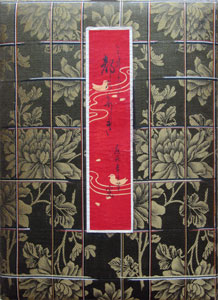 Mizuno Toshikata (1866-1908) - Mitsui Gonomi Miyako no Nishiki: Front cover |
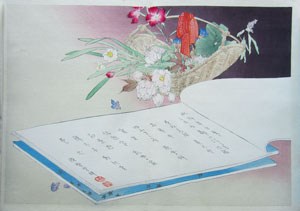 Mizuno Toshikata (1866-1908) - Mitsui Gonomi Miyako no Nishiki: Title page/Table of contents |
|
-thumbnail.jpg) Mizuno Toshikata (1866-1908) - Mitsui Gonomi Miyako no Nishiki: Spring - Parting of School-Chums |
-thumbnail.jpg) Mizuno Toshikata (1866-1908) - Mitsui Gonomi Miyako no Nishiki: Spring - An outing in a field |
-thumbnail.jpg) Mizuno Toshikata (1866-1908) - Mitsui Gonomi Miyako no Nishiki: Summer - Keeping off cloth-moths |
-thumbnail.jpg) Mizuno Toshikata (1866-1908) - Mitsui Gonomi Miyako no Nishiki: Summer - A cool breeze of evening |
-thumbnail.jpg) Mizuno Toshikata (1866-1908) - Mitsui Gonomi Miyako no Nishiki: Summer - An evening blossom of yakaiso (ball flower) |
-thumbnail.jpg) Mizuno Toshikata (1866-1908) - Mitsui Gonomi Miyako no Nishiki: Autumn - Sketching out-door |
-thumbnail.jpg) Mizuno Toshikata (1866-1908) - Mitsui Gonomi Miyako no Nishiki: Autumn - On a look out for a new season dress at Mitsui-Gofukuten |
-thumbnail.jpg) Mizuno Toshikata (1866-1908) - Mitsui Gonomi Miyako no Nishiki: Autumn - A walk to a country-cottage |
-thumbnail.jpg) Mizuno Toshikata (1866-1908) - Mitsui Gonomi Miyako no Nishiki: Autumn - A bright tint of maple foliage |
-thumbnail.jpg) Mizuno Toshikata (1866-1908) - Mitsui Gonomi Miyako no Nishiki: Winter - A visit from a neighbor’s petty favorite |
-thumbnail.jpg) Mizuno Toshikata (1866-1908) - Mitsui Gonomi Miyako no Nishiki: Winter - A snowy morning |
-thumbnail.jpg) Mizuno Toshikata (1866-1908) - Mitsui Gonomi Miyako no Nishiki: Winter - Snow viewing |
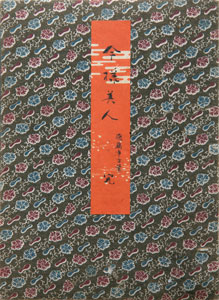 Mizuno Toshikata (1866-1908) - Imayō Bijin: Front cover |
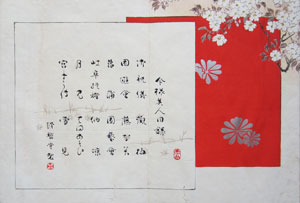 Mizuno Toshikata (1866-1908) - Imayō Bijin: Title page/Table of contents |
|
-2-thumbnail.jpg) Mizuno Toshikata (1866-1908) - Imayō Bijin: Celebration ceremony |
-2-thumbnail.jpg) Mizuno Toshikata (1866-1908) - Imayō Bijin: Plum blossom viewing |
-2-thumbnail.jpg) Mizuno Toshikata (1866-1908) - Imayō Bijin: Garden play party |
-2-thumbnail.jpg) Mizuno Toshikata (1866-1908) - Imayō Bijin: Wisteria wave |
-2-thumbnail.jpg) Mizuno Toshikata (1866-1908) - Imayō Bijin: Japanese irises |
-2-thumbnail.jpg) Mizuno Toshikata (1866-1908) - Imayō Bijin: Gardening party |
-2-thumbnail.jpg) Mizuno Toshikata (1866-1908) - Imayō Bijin: Gifu paper lantern |
-2-thumbnail.jpg) Mizuno Toshikata (1866-1908) - Imayō Bijin: Cool of the evening |
-2-thumbnail.jpg) Mizuno Toshikata (1866-1908) - Imayō Bijin: Moon viewing |
-2-thumbnail.jpg) Mizuno Toshikata (1866-1908) - Imayō Bijin: Playing at the beach |
-2-thumbnail.jpg) Mizuno Toshikata (1866-1908) - Imayō Bijin: Fluttering near a shrine |
-2-thumbnail.jpg) Mizuno Toshikata (1866-1908) - Imayō Bijin: Snow viewing |
 Mizuno Hidekata (1875-1944) - Katei no Hana: Front Cover |
 Mizuno Hidekata (1875-1944) - Katei no Hana: Title page/Table of contents |
|
 Mizuno Hidekata (1875-1944) - Katei no Hana: Beginning of the Year |
 Mizuno Hidekata (1875-1944) - Katei no Hana: The Odor of the plum Blooms |
 Mizuno Hidekata (1875-1944) - Katei no Hana: Vernal Equinox |
 Mizuno Hidekata (1875-1944) - Katei no Hana: A Sick Visit |
 Mizuno Hidekata (1875-1944) - Katei no Hana: Play |
 Mizuno Hidekata (1875-1944) - Katei no Hana: After the Shower |
 Mizuno Hidekata (1875-1944) - Katei no Hana: The School Girl |
 Mizuno Hidekata (1875-1944) - Katei no Hana: Mid-Summer Dream |
 Mizuno Hidekata (1875-1944) - Katei no Hana: Sudden Shower |
 Mizuno Hidekata (1875-1944) - Katei no Hana: The Teacher and I |
 Mizuno Hidekata (1875-1944) - Katei no Hana: A Slight Token of Esteem |
 Mizuno Hidekata (1875-1944) - Katei no Hana: After School |
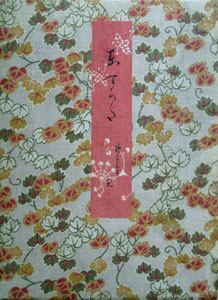 Tsugumi Bihō (1868-1912) - Azuma Sugata: Front cover |
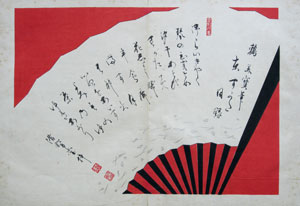 Tsugumi Bihō (1868-1912) - Azuma Sugata: Title page/Table of contents |
|
-thumbnail.jpg) Tsugumi Bihō (1868-1912) - Azuma Sugata: A visitor |
-thumbnail.jpg) Tsugumi Bihō (1868-1912) - Azuma Sugata: First koto playing of the year |
-thumbnail.jpg) Tsugumi Bihō (1868-1912) - Azuma Sugata: Gathering shells |
-thumbnail.jpg) Tsugumi Bihō (1868-1912) - Azuma Sugata: Full-length mirror |
-thumbnail.jpg) Tsugumi Bihō (1868-1912) - Azuma Sugata: Irises |
-thumbnail.jpg) Tsugumi Bihō (1868-1912) - Azuma Sugata: Half a kaiseki |
-thumbnail.jpg) Tsugumi Bihō (1868-1912) - Azuma Sugata: Full moon |
-thumbnail.jpg) Tsugumi Bihō (1868-1912) - Azuma Sugata: Fireworks |
-thumbnail.jpg) Tsugumi Bihō (1868-1912) - Azuma Sugata: Loving the dog |
-thumbnail.jpg) Tsugumi Bihō (1868-1912) - Azuma Sugata: Reading matter |
-thumbnail.jpg) Tsugumi Bihō (1868-1912) - Azuma Sugata: Tea ceremony |
-thumbnail.jpg) Tsugumi Bihō (1868-1912) - Azuma Sugata: After the snow |
 Yamamoto Shōun (1870-1965) - Shiki no Nagame: Front cover |
||
-thumbnail.jpg) Yamamoto Shōun (1870-1965) - Shiki no Nagame: Bustle at the gate |
-thumbnail.jpg) Yamamoto Shōun (1870-1965) - Shiki no Nagame: The bride |
-thumbnail.jpg) Yamamoto Shōun (1870-1965) - Shiki no Nagame: Hina dolls |
-thumbnail.jpg) Yamamoto Shōun (1870-1965) - Shiki no Nagame: Spring haze |
-thumbnail.jpg) Yamamoto Shōun (1870-1965) - Shiki no Nagame: Seashore |
-thumbnail.jpg) Yamamoto Shōun (1870-1965) - Shiki no Nagame: Voice of reading |
-thumbnail.jpg) Yamamoto Shōun (1870-1965) - Shiki no Nagame: Please eat |
-thumbnail.jpg) Yamamoto Shōun (1870-1965) - Shiki no Nagame: Sound of insects |
-thumbnail.jpg) Yamamoto Shōun (1870-1965) - Shiki no Nagame: Evening cool |
-thumbnail.jpg) Yamamoto Shōun (1870-1965) - Shiki no Nagame: Moonlit night |
-thumbnail.jpg) Yamamoto Shōun (1870-1965) - Shiki no Nagame: Chatting |
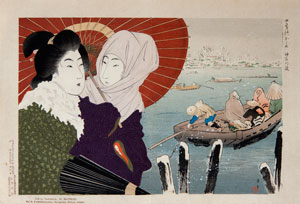 Yamamoto Shōun (1870-1965) - Shiki no Nagame: Ferry in snow |
-thumbnail.jpg) Yamamoto Shōun (1870-1965) - Kodomo Asobi (1): Playing house |
||
-thumbnail.jpg) Yamamoto Shōun (1870-1965) - Kodomo Asobi (3): Hunting in a river |
-thumbnail.jpg) Yamamoto Shōun (1870-1965) - Kodomo Asobi (3): Moon rise |
-thumbnail.jpg) Yamamoto Shōun (1870-1965) - Kodomo Asobi (3): Persimmon |
-thumbnail.jpg) Yamamoto Shōun (1870-1965) - Kodomo Asobi (3): Up and down |
||
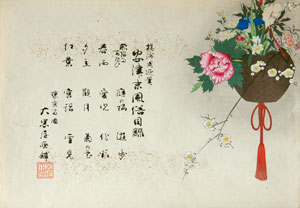 Yōshū Chikanobu (1838-1912) - Azuma Fūzoku: Title page/Table of contents |
||
-thumbnail.jpg) Yōshū Chikanobu (1838-1912) - Azuma Fūzoku: Playing cards |
-thumbnail.jpg) Yōshū Chikanobu (1838-1912) - Azuma Fūzoku: Backyard cherry tree |
-thumbnail.jpg) Yōshū Chikanobu (1838-1912) - Azuma Fūzoku: Spring rain |
-thumbnail.jpg) Yōshū Chikanobu (1838-1912) - Azuma Fūzoku: Beloved child |
-thumbnail.jpg) Yōshū Chikanobu (1838-1912) - Azuma Fūzoku: Make-up |
-thumbnail.jpg) Yōshū Chikanobu (1838-1912) - Azuma Fūzoku: Sudden evening shower |
-thumbnail.jpg) Yōshū Chikanobu (1838-1912) - Azuma Fūzoku: Moon viewing |
-thumbnail.jpg) Yōshū Chikanobu (1838-1912) - Azuma Fūzoku: Visiting a shrine |
|
-thumbnail.jpg) Arai Kanpo (1878-1945) - Shōnen Rekishi: The Soga brothers |
-thumbnail.jpg) Arai Kanpo (1878-1945) - Shōnen Rekishi: Shōtoku Taishi |
-thumbnail.jpg) Arai Kanpo (1878-1945) - Shōnen Rekishi: Murasaki Shikibu |