Shin Hanga prints
During and after the Meiji era, many professional woodblock printers and carvers were forced to turn to other jobs to make a living. Only some craftsmen raised in the traditional art of woodblock printmaking were able to continue working, based on the well-established quartet always consisting of four people: the publisher, the designer, the carver, and the printer. After the Meiji era the traditional Japanese co-operation of four different professionals producing woodblock prints were called the Shin Hanga (literally meaning New Prints) movement.
In the 20th century publisher Watanabe Shōzaburō (who was responsible for publishing the prints designed by Kawase Hasui and Itō Shinsui for example) was instrumental in reviving this tradition of producing Japanese woodblock prints. The French artist Paul Jacoulet - living almost all his life (including the Second World War) in Japan - also hired professional Japanese carvers and printers for the production of his woodblock prints, and - acknowledging their stupendous skills - added their names to most of his prints.
One woodblock carver - not only responsible for the blocks of the prints designed by Paul Jacoulet, but also for some of those designed by Kawase Hasui, Torii Kotondo, Yoshio Okada, and Tatsumi Shimura for example - particularly stands out for his enormous craftmanship during this most recent time of Japanese history. His name is Kentarō Maeda (ca.1900-1987).
During this very same post-Meiji period the what is known as the Sosaku Hanga (literally meaning Creative Prints) movement was receiving much more attention from art reviewers (both abroad and in Japan) than the Shin Hanga movement. Artists of the Sosaku Hanga movement typically did all the work (the publishing, designing, carving, and printing of their designs) themselves, claiming that the technical skills required in the carving and printing of woodblock prints would only hinder their artistic expression in the woodblock printing medium. These are examples of the type of prints produced by the Sosaku Hanga movement (click on the images to obtain larger views of the prints):
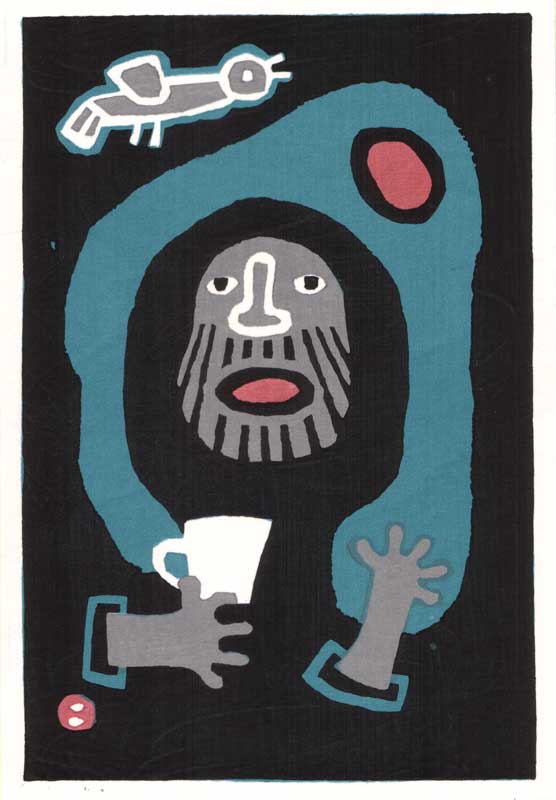 |
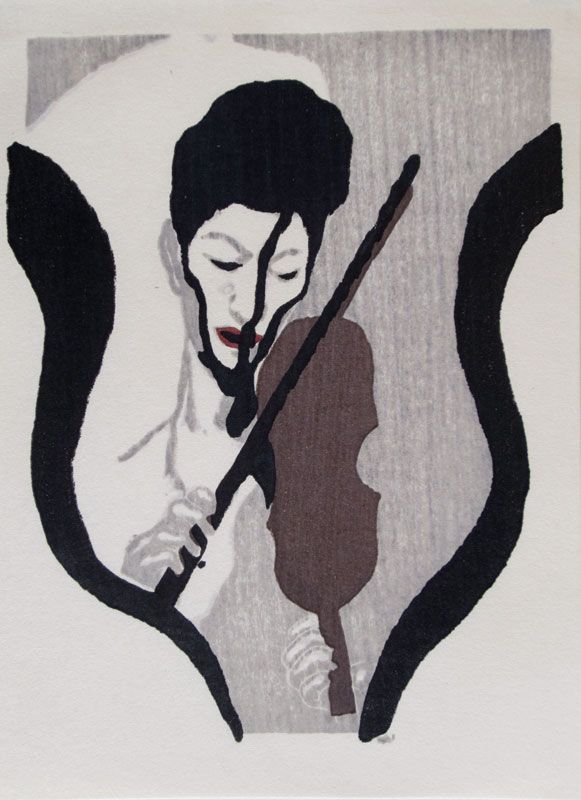 |
| Umetaro Azechi - Repose | Koshiro Onchi - Impression of a Violinist |
The print on the left is the frontispiece of a book on woodblock printing techniques written by Umetaro Azechi, a book that can be viewed on my website here. The print on the right is the frontispiece of a book on Sosaku Hanga artists written by Oliver Statler, a book that can be viewed on my website here. The latter print is also illustrated and discussed on page 228 of the book Waves of Renewal. Modern Japanese Prints 1900-1960 written by Uhlenbeck, Newland, and de Vries (2016). As for the different goals aspired to by members of the Shin Hanga and Sosaku Hanga movements, Tōshi Yoshida - first author of this book on Japanese woodblock techniques, and son of the famous Shin Hanga artist Hiroshi Yoshida - mentions that:
‘ ... it may be said that the modern (i.e. creative) print movement started as a drastic reaction to the decadence of the ukiyo-e, which had become overripe in technical skill but quite impoverished in artistic value.’
Later in life, however, Tōshi Yoshida reverted to the Shin Hanga style of producing woodblock prints, as is witnessed by his print ‘Ship Rock’ shown below.
The prints displayed on this webpage clearly point out my preference for those produced by the Shin Hanga artists, disregarding - I am afraid - those made by members of the Sosaku Hanga movement.
To find out more about the Shin Hanga prints shown on this page - their size, publication date, provenance, enlargements, the English translation of the Japanese texts on each print, et cetera - please click on any of the images shown below.
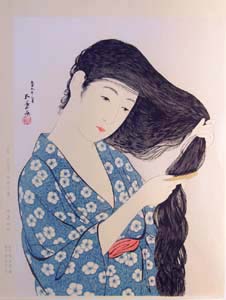 Hashiguchi Goyō (1880-1921) - Woman combing her hair |
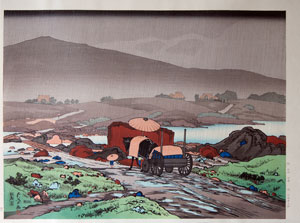 Hashiguchi Goyō (1880-1921) - Rain at Yabakei |
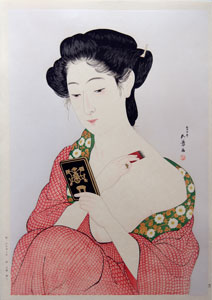 Hashiguchi Goyō (1880-1921) - Woman applying makeup |
|
-thumbnail.jpg) Kawase Hasui (1883-1957) - Tengu Rock at Shiobara |
-thumbnail.jpg) Kawase Hasui (1883-1957) - Full moon at Magome |
-thumbnail.jpg) Kawase Hasui (1883-1957) - Senju Waterfall, Akame |
|
-thumbnail-new.jpg) Kawase Hasui (1883-1957) - Evening shower at Imai Bridge |
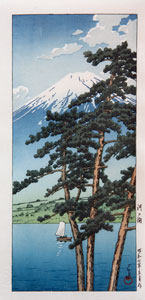 Kawase Hasui (1883-1957) - Lake Kawaguchi |
-thumbnail.jpg) Kawase Hasui (1883-1957) - Onshi Park, Shiba |
|
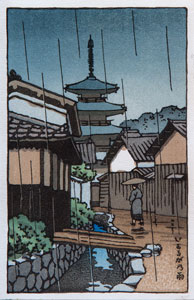 Kawase Hasui (1883-1957) - Pagoda in rain |
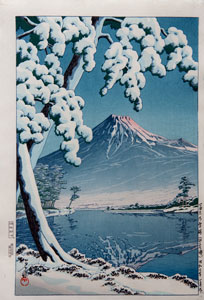 Kawase Hasui (1883-1957) - Fuji No Yukibare (Tagonoura) |
-thumbnail.jpg) Kawase Hasui (1883-1957) - Autumn at Shiobara |
|
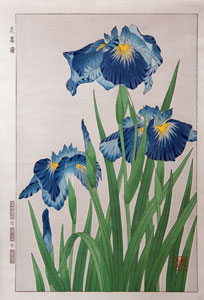 Kawarazaki Shōdō (1889-1973) - Irises |
-thumbnail.jpg) Itō Shinsui (1898-1972) - Frosty morning |
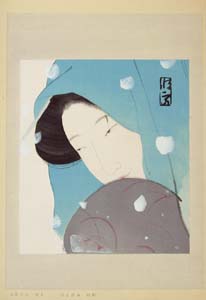 Kitano Tsunetomi (1880-1947) - The heroine Umekawa in ‘Meido no Hikyaku’ |
|
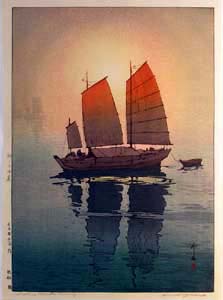 Hiroshi Yoshida (1876-1950) - Sailing boats: Morning |
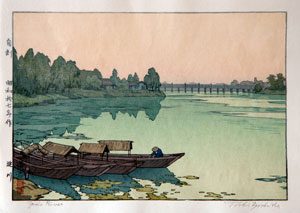 Tōshi Yoshida (1911-1995) - Yodo River |
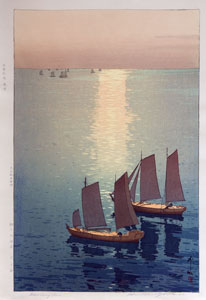 Hiroshi Yoshida (1876-1950) - Glittering sea |
|
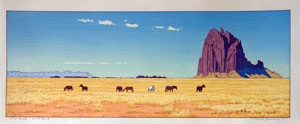 Tōshi Yoshida (1911-1995) - Ship Rock |
|||
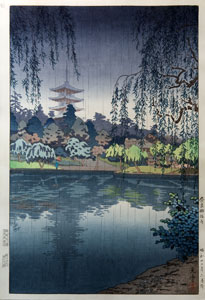 Tsuchiya Kōitsu (1870-1949) - Nara Kōfuku temple |
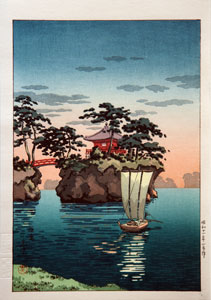 Tsuchiya Kōitsu (1870-1949) - Matsushima |
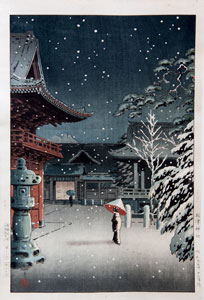 Tsuchiya Kōitsu (1870-1949) - Nezu shrine |
|
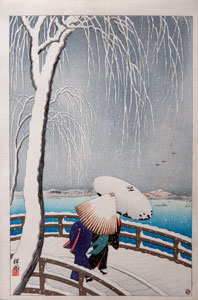 Ohara Koson (1877-1945) - Snow at Yanagibashi |
-thumbnail.jpg) Tsuchiya Kōitsu (1870-1949) - Aki Miyajima |
-thumbnail.jpg) Ishii Hakutei (1882-1958) - Shibaura |
|
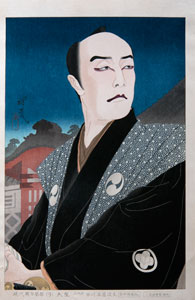 Ota Masamitsu (1892-1975) - Gendai Butai Geika: 9 Ōboshi Ichikawa Sadanji III |
|||
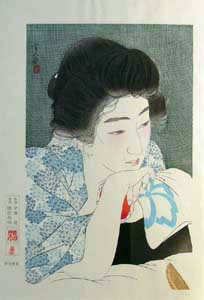 Torii Kotondo (1900-1976) - Morning hair |
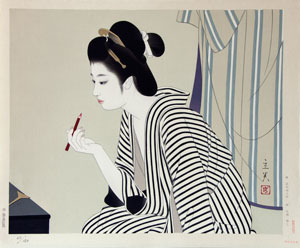 Shimura Tatsumi (1907-1980) - Lipstick |
-thumbnail.jpg) Torii Kotondo (1900-1976) - Combing her hair |
|
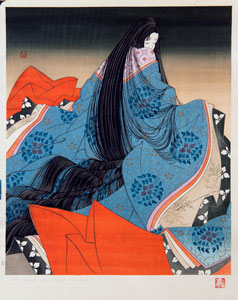 Okada Yoshio (1934-2021) - Genji emaki: Akashi |
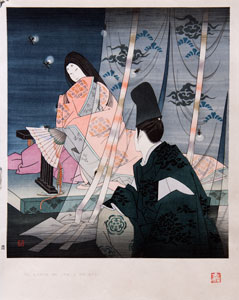 Okada Yoshio (1934-2021) - Genji emaki: Hotaru |
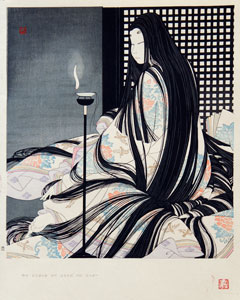 Okada Yoshio (1934-2021) - Genji emaki: Wakana |
|
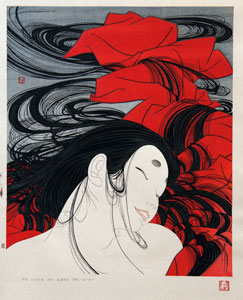 Okada Yoshio (1934-2021) - Genji emaki: Matsukaze |
|||
 David Bull (1951) - Ato |
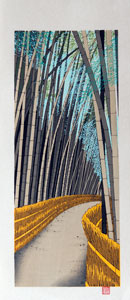 Teruhide Kato (1936-2015) - Bamboo forest - Sagano |
||
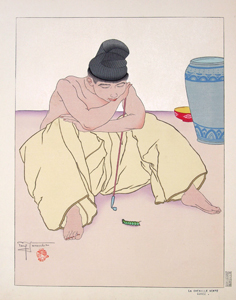 Paul Jacoulet (1896-1960) - La chenille verte. Corée. |
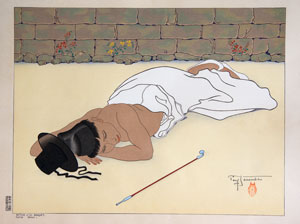 Paul Jacoulet (1896-1960) - Retour d’un banquet. Corée Seoul. |
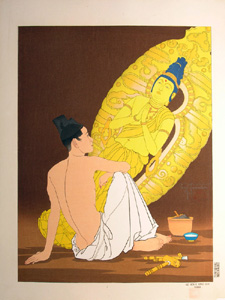 Paul Jacoulet (1896-1960) - Le génie sans nom. Corée. |
|
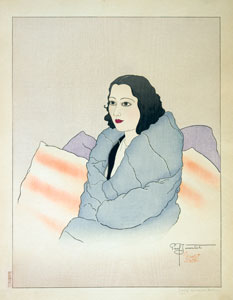 Paul Jacoulet (1896-1960) - Beauté Japonaise Moderne. Kobé |
|||
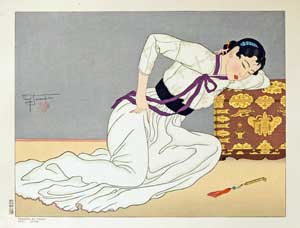 Paul Jacoulet (1896-1960) - Tempête du Coeur Séoul Corée |
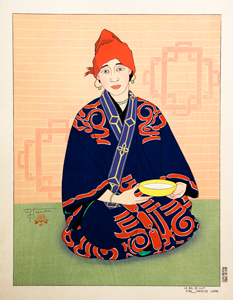 Paul Jacoulet (1896-1960) - Le bol de lait Aino_Hokkaido Japon |
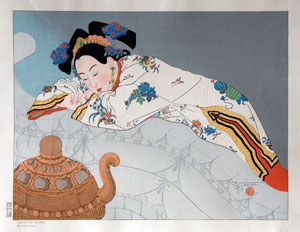 Paul Jacoulet (1896-1960) - Fumées de Santal Mandchoukuo |
|
-thumbnail.jpg) Osamu Sugiyama (1946) - Climbing up along Snow Ridge |
-thumbnail.jpg) Gary Luedtke (1947) - Kalalau, Kauai |