Meiji prints
| Design: | Ikeda Terukata (1883-1921) | |||||
| Print title: | Title page/Introduction/Table of contents print | |||||
| Album/series title: | Edo no Nishiki (Brocade pictures of Edo) | |||||
| Size: | 21.1 x 31.7 cm (ōban) | |||||
| Original woodblock print | ||||||
| Photography: | Jacques Commandeur |
|


|

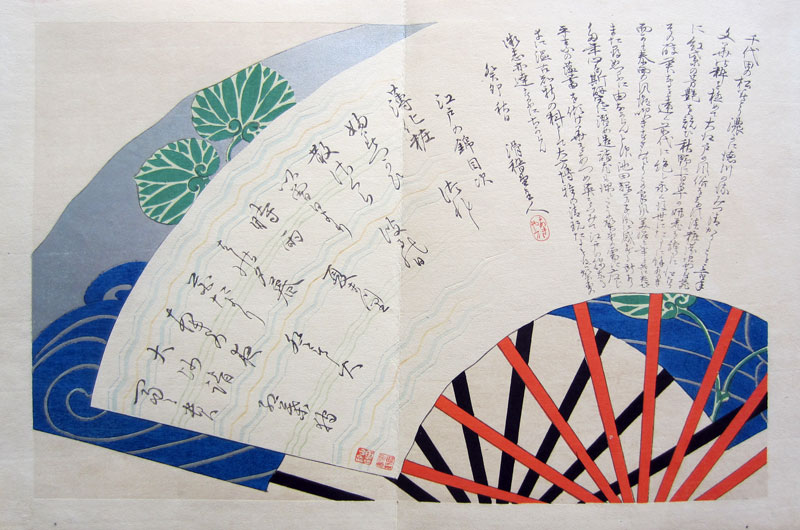
Special effects: silver metallic pigments on the second fan in the background.
The Japanese text in this print*) contains an introduction to the Edo no Nishiki album and its table of contents. In the introduction publisher Akiyama Buemon explains his reasons for publishing this album. The sixth column from the right of the text mentions the name of the designer of the prints in this album:
| Character | Reading | Meaning | Translation |
| 池 | ike | pond | |
| 田 | ta | ricefield | |
| 輝 | kagaya(ku) | shine | |
| 方 | kata | person | Ikeda Terukata |
The ninth column from the right contains the following yojijukugo (four character compound):
| Character | Reading | Meaning | Translation |
| 温 | on | warm | |
| 故 | ko | the late | |
| 知 | chi | wisdom | |
| 新 | shin | new | To learn from the past |
One of the reasons for publishing this album was thus “to discover new things by studying the past”, or “to learn from the past”.
Publishing date and publisher’s firm name in left most column of the introduction text:
| Character | Reading | Meaning | Translation |
| 葵 | mizunoto | water | |
| 卯 | u | rabbit | Water Rabbit**) (= 1903), |
| 秋 | shū | autumn | |
| 日 | jitsu | day | an autumn day |
| 滑 | kotsu | slide | |
| 稽 | kei | think | |
| 堂 | dō | temple | Kokkeidō |
| 主 | shu | chief | |
| 人 | jin | person | proprietor |
Followed by a red oval seal with the publisher’s name:
| Character | Reading | Meaning | Translation |
| あ | a | ||
| き | ki | ||
| や | ya | ||
| 万 | man | ten thousand | Akiyama |
Album title in the next column of the text:
| Character | Reading | Meaning | Translation |
| 江 | e | bay | |
| 戸 | do | door | |
| の | no | ’s | Brocade pictures |
| 錦 | nishiki | brocade | of Edo |
| 目 | moku | eye | |
| 次 | ji | next | Table of contents |
Followed by the titles of the fifteen individual prints:
| Character | Reading | Meaning | Translation |
| 薄 | usu | light | |
| 化 | ge | change | |
| 粧 | shō | adorn | Light make-up |
| 徒 | tsure | emptiness | |
| 然 | dzure | -like | Tediousness |
| 媚 | ko | flirt | |
| 美 | bi | beauty | |
| つ | tsu | ||
| 可 | ka | Flirting beauty | |
| ひ | hi | mission | on a mission |
| 散 | chiri | fall | |
| 佐 | sa | ||
| く | ku | Falling | |
| ら | ra | cherry blossoms | cherry blossoms |
| 波 | ha | ||
| る | ru | ||
| 能 | no | ||
| 日 | hi | day | Spring day |
| 以 | i | ||
| 曽 | so | beach | |
| 日 | hi | ||
| よ | yo | Fine weather | |
| 利 | ri | fine weather | at the beach |
| 時 | shi | ||
| 雨 | gure | Seasonal rain | |
| 夏 | natsu | summer | |
| ま | ma | ||
| 川 | tsu | ||
| 里 | ri | festival | Summer festival |
| 者 | ha | ||
| し | shi | bridge | |
| 能 | no | ’s | |
| 夕 | yū | ||
| 暮 | gure | twilight | Twilight on a bridge |
| 花 | hana | flower | |
| た | ta | ||
| よ | yo | ||
| り | ri | letter | Flower letter |
| 燈 | to | ||
| 毛 | mo | ||
| し | shi | ||
| 火 | bi | lamp | A lantern |
| あ | a | ||
| き | ki | autumn | |
| の | no | ’s | |
| 夜 | yoru | evening | Autumn evening |
| 大 | ō | big | |
| 沙 | sa | sand | |
| 渚 | sho | shore | Big shore |
| 紅 | mo | red | |
| 葉 | miji | leaf | |
| 狩 | gari | hunt | Autumn-leaf viewing |
| 冨 | fu | ||
| 々 | bu | ||
| 貴 | ki | snow storm | Snow storm |
Red square seals with the names of the printer and carver in the left bottom of the front fan in this print:
| Character | Reading | Meaning | Translation |
| 印 | in | stamp | |
| 刷 | satsu | Printer: | |
| 山 | yama | mountain | |
| 田 | ta | rice field | Yamada |
| 彫 | ho(ru) | carve | |
| 匠 | shō | artisan | Carver: |
| 宗 | mune | religion | |
| 岡 | oka | hill | Muneoka |
The full name of the carver is Muneoka Shinkichi (1862-1929).
References
- Martin, Katherine (2006). Highlights of Japanese printmaking. Part 2: Shin Hanga. New York: Scholten Japanese Art.
- Narazaki, Muneshige, ed. (1990). Ukiyo-e Masterpieces in Western collections. The Robert O. Muller Collection. Tokyo: Kodansha International.
- Newland, Amy Reigle, and Shinji, Hamanaka (2000). The female image. Leiden: Hotei Publishing.
- Newland, Amy Reigle (2021). Printed and painted. The Meiji art of Ogata Gekkō (1859-1920). Leiden: Hotei Publishing.
Provenance: Second-hand bookstore Sugimoto Ryoedo in Osaka.
*) With many thanks to Naoko and Shinji Ōba for helping me with the translation of the text in this print.
**) This way of recording years combines the five elements of wood, fire, earth, metal, and water with the twelve animals of the Chinese zodiac signs consisting of the rat, the ox, the tiger, the rabbit, the dragon, the snake, the horse, the goat, the monkey, the rooster, the dog, and the pig to obtain a (five times twelve equals) sixty year or sexagenary cycle. According to this system, the last four years combining the element of water with the animal sign of the rabbit are the years 1843, 1903, 1963, and 2023. This clearly indicates that Ikeda Terukata’s Edo no Nishiki album was published in the year 1903. For more information on the Chinese sexagenary cycle please refer to this Wikipedia page.